Click to rate this post!
[Total: 3 Average: 3.7]
You must sign in to vote

Really gives you an idea of how ancient Romans lived. For the independent traveller there is an additional advantage over Pompei. There are far fewer visitors to Herculaneum than Pompei and you can explore the ruins at leisure without being overwhelmed by tour groups.
These excavations also cover a much smaller site than do those of Pompei and thus seeing the whole site is much less exhausting.

Herculaneum was destroyed by an eruption of Mt. Vesuvius in AD 79, the same eruption that destroyed Pompei.

After it has been sent, you will be contacted as soon as possible. Thank you.
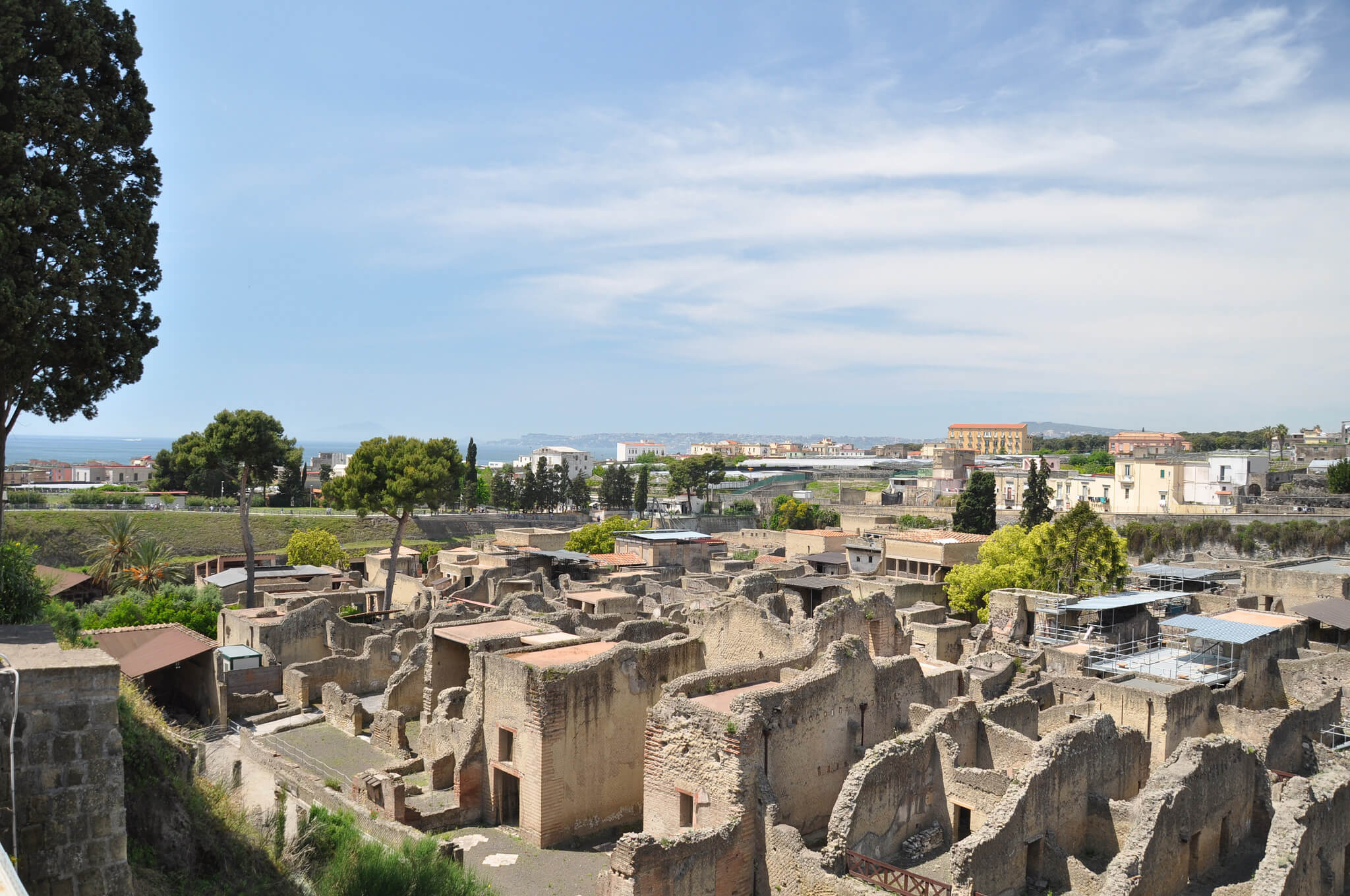
In many ways Herculaneum is arguably a more interesting place to visit than Pompeii. Surrounded by volcanic rock, its location gives you a far clearer idea of the magnitude of the volcanic eruption. While roofs in Pompei collapsed under the weight of falling ash, only a few centimetres of ash fell on Herculaneum, causing little damage.
Subsequently, there was a succession of six flows of boiling mud (a mixture of ash and gases) which then solidified. These gradually buried the city’s buildings from the bottom up, causing relatively little damage. The good state of preservation of the site is due to its rapid filling by these flows, which prevented the buildings from collapsing. The high temperature of the first flow carbonized wood in the buildings and extracted water from it.
Restoration work is ongoing, and while a lot of the timbers have been replaced, there is still much of the original timberwork present, albeit, badly charred. Finally, the volcanic rock, ortufo, that covered the site for 1700 years formed an airtight seal. As a consequence there are many well-preserved buildings, many with the upper stories still intact, and some excellent frescoes and mosaics on both walls and floors to be seen.
Additional Excavations Herculaneum Tips
Walking shoes, or those with low heels, are highly recommended. In addition, in warmer weather you may want to bring your own bottle of water. For those with much younger children I advise a backpack style carrier if your stroller is not heavy duty and up to the ancient Roman roads. Allow 2-3 hours to tour the site.
Access
Corso Resina, Ercolano (NA)
School parties must book in advance
For all information:
Sezione Didattica – tel: +39 081 8575331
School parties’ admission and reservations
Opening Times
November – March, every day from 8.30 a.m. to 5 p.m. (last admission 3.30 p.m.)
April – October, every day from 8.30 a.m. to 7.30 p.m. (last admission 6 p.m.)
Closed: 1 January, 1 May, 25 December
Main Routes
by train:
Circumvesuviana Napoli-Sorrento or Napoli-Poggiomarino or Napoli -Torre Annunziata (stop Ercolano)
by car:
Autostrada A3 Napoli-Salerno (exit Ercolano)
Admission
Single ticket – valid for 1 day
Full price: € 11.00
Half price: € 5.50 (*)
Free of charge: for EU citizens under 18 or over 65 years old.
(*) Reductions: for EU citizens aged 18-24 and EU permanent school teachers.
Reductions and free tickets can be issued only by showing a valid document (passport, identity card, driving license).

 and even if you stroll you won’t need much more time than that.
Address:
Via IV Novembre n.44 80056 – Ercolano (NA)
E-mail: info@museomav.it
Telephone:+39 081-19806511
Fax: +39 081-19806599
http://www.museomav.it
MAV (Museo Archeologico Virtuale), Via 4 Novembre 44 (200m up the hill from the entrance to the excavations: on the left.), (info@museomav.it). 09.00-17.30 Tues-Sun. An enjoyable interactive museum that recreates life as it was in Herculaneum and Pompei before the eruption. Great fun for kids, although some parents may not appreciate the virtual visit to one of Pompei’s brothels! Buildings are reconstructed before your eyes at a wave of your hand; you can brush ash off a fresco; make a virtual pool of water over a mosaic ripple; see 3-D images of jewelry found at the sites; walk next to marching legionaries; learn of the lifestyle of the Roman times at an interactive table, and visit public baths and the brothel! €7.50 (reduced €6.00)
A dip into the past through a multisensory experience, to learn and discover in detail, a dive into the past through a multisensory experience, to learn and discover in detail the historical realities of Herculaneum and Pompeii before the eruption of the Vesuvius 79 AD. This is the mission of the MAV structure that was created in the heart of Herculaneum and provides new ways of using cultural.
The visitor will be transported in a virtual context faithfully reconstructed by the use of modern technologies.
The journey begins after passing a sort of ancestral door dematerialized bodies in streams and connective intelligence leading to the discovery of names and faces of the ancient Herculaneum, with which it is aware of the history of the community and their way living.